
Digital dentistry in Truro
See what two dimensions can miss.
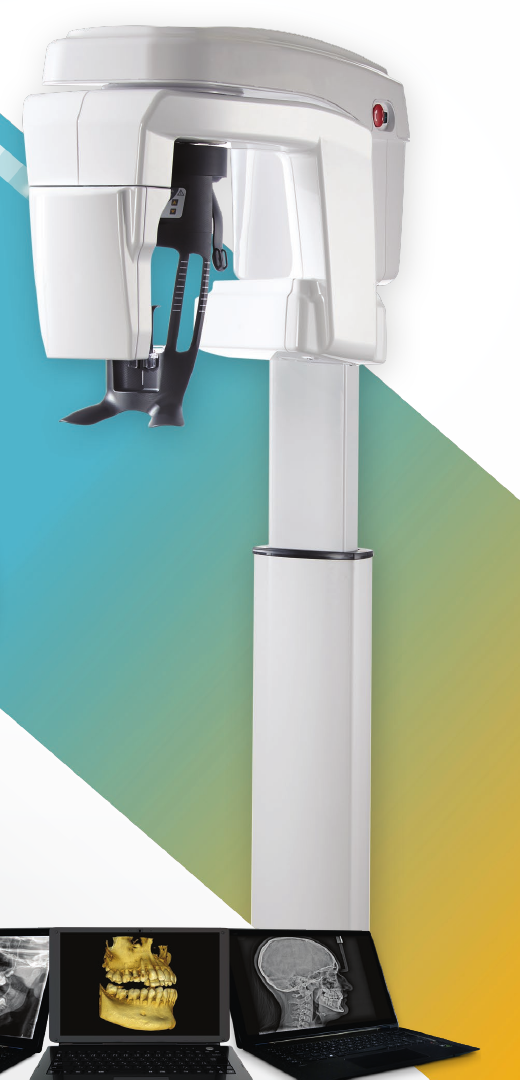
CBCT stands for cone beam computed tomography. Like a medical CT scan, it creates three-dimensional images, but uses a smaller field designed for dental applications. It can show teeth, roots, bone and nearby structures when an ordinary dental X-ray does not provide enough information.
More information, only when it can change care.
A normal dental X-ray is two-dimensional. CBCT builds a three-dimensional volume that can be viewed as thin cross-sectional slices, helping the clinician understand depth and the relationship between important structures.
That extra information is valuable in selected cases, but it is not needed for every patient. We first consider your examination, existing images and whether a conventional X-ray can answer the question.
2D imaging on the same machine
An easier option for a strong gag reflex.
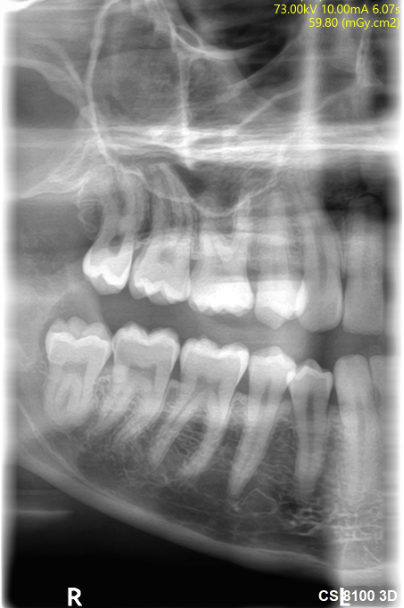
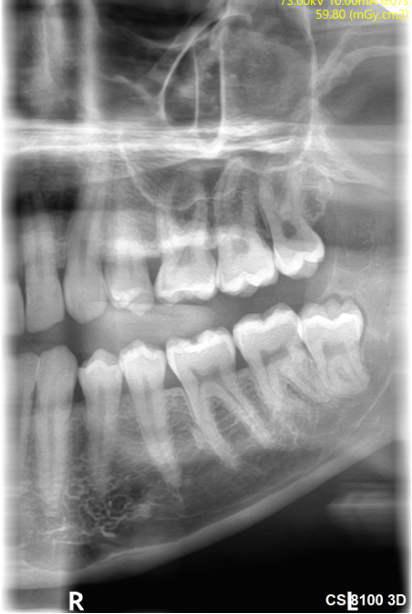
Our Carestream CS 8100 3D can also take an extraoral bitewing-style 2D X-ray. You bite gently on a small support at the front teeth, with no large X-ray film or sensor positioned at the back of the mouth.
When it may help
- Can be easier for children, patients with a strong gag reflex or anyone who finds a film or sensor at the back of the mouth difficult.
- Shows a wider area of the jaws and surrounding bone than a small intraoral image.
- May give an overview of impacted teeth, general periodontal bone levels and the lower jaw nerve canal.
- It is less accurate than a good intraoral bitewing for detecting fine early decay, so we will advise which type of X-ray is most suitable.
When CBCT may help
Detail for decisions that need it.
The reason for the scan determines the area captured and how it is assessed.
Bone and planning
Assess available bone and nearby structures when planning suitable dental implants.
Complex anatomy
Investigate selected roots, lesions or anatomy where conventional images do not provide enough information for root canal treatment.
Teeth and nerves
Review impacted teeth and their relationship to nearby structures when planning selected wisdom tooth cases.
Bone and pathology
Help assess resorption, fractures, unerupted teeth or suspected jaw lesions when three-dimensional detail may alter the plan.
The same area, viewed differently
One scan. Three directions.
The CBCT volume can be reviewed from above, from the front and from the side. The clinician can move through the scan slice by slice instead of relying on one flat image.
Your appointment
Position. Scan. Review.
The scan is quick, and you can return to normal activities straight afterwards.
We help you get comfortable
Your head is positioned carefully so the scanner can capture the area your clinician needs to assess.
The scanner moves around you
You stand or sit still while the machine moves around your head. The scan itself is brief and painless.
Findings guide the next step
The scan is reviewed by an appropriately trained clinician or radiologist. We explain the relevant findings and how they affect your care.
Radiation protection
Useful detail with careful dose control.
CBCT uses ionising radiation. The dose varies with the area scanned, the equipment and the settings. It is generally lower than a conventional medical CT scan of the same area, but higher than ordinary two-dimensional dental X-rays.
That is why we do not use CBCT routinely. The expected clinical benefit must outweigh the radiation risk, and the scan is optimised for its intended purpose.
Fees and referrals
Clear routes for patients and dentists.
The fee depends on the area scanned and the reporting required. Your clinician or our team will confirm the appropriate scan and cost before it is taken. Consultation and treatment are charged separately where required.
Are you a referring clinician?
We accept professional referrals for sectional, single-arch and dual-arch CBCT imaging. Please include the clinical question, relevant history and suitable existing images. The patient must consent to the referral.
Connected care
Imaging supports the wider plan.
Common questions
CBCT scan FAQs.
What does the scan feel like?
The scan is quick and painless. You stand or sit still while the machine moves around your head without touching you.
Does this machine always take a 3D scan?
No. The Carestream CS 8100 3D can produce both 2D and 3D dental X-rays. We select the type of image that is suitable for the clinical question; a CBCT scan is only used when the additional three-dimensional information is justified.
How long does it take?
Positioning and checks take a few minutes. The scan itself usually takes less than a minute, although the exact appointment time depends on the area being examined and the records required.
Is CBCT the same as a normal dental X-ray?
No. Ordinary dental X-rays produce a two-dimensional image and are sufficient for many situations. CBCT creates a three-dimensional volume and is reserved for cases where the extra information is expected to help diagnosis or treatment planning.
How much radiation is involved?
The dose varies with the size of the area scanned and the scan settings. A dental CBCT generally uses less radiation than a conventional medical CT scan of the same area, but more than routine two-dimensional dental X-rays. We justify each scan and use the smallest suitable field of view.
Can I have a scan if I am pregnant?
Please tell us if you are pregnant or think you might be pregnant. The clinician will consider the clinical need, timing, alternatives and radiation protection requirements before deciding whether the scan should proceed.
Do I need a CBCT before every implant or root canal treatment?
No. CBCT is not automatic. It is recommended only when the expected three-dimensional information is useful enough to justify the exposure and cannot be obtained adequately from the examination and lower-dose imaging.
Who looks at the scan?
The scan is clinically evaluated by a suitably trained clinician or radiologist, depending on the scan and referral. Relevant findings are recorded and shared with the referring clinician or used in your treatment planning.
Start with the clinical question
Would three-dimensional imaging help?
Contact our team and we will guide you to the right assessment or imaging appointment. Dentists can refer securely through our professional referral form.