Persistent infection
Symptoms or a lesion remain around the root tip despite technically satisfactory root canal treatment.

Oral surgery – Apicectomy in Truro
An apicectomy is a small surgical procedure that removes infection around the end of a previously root-treated tooth and seals the root from its tip. It may help retain a tooth when non-surgical retreatment is not suitable or has not worked.
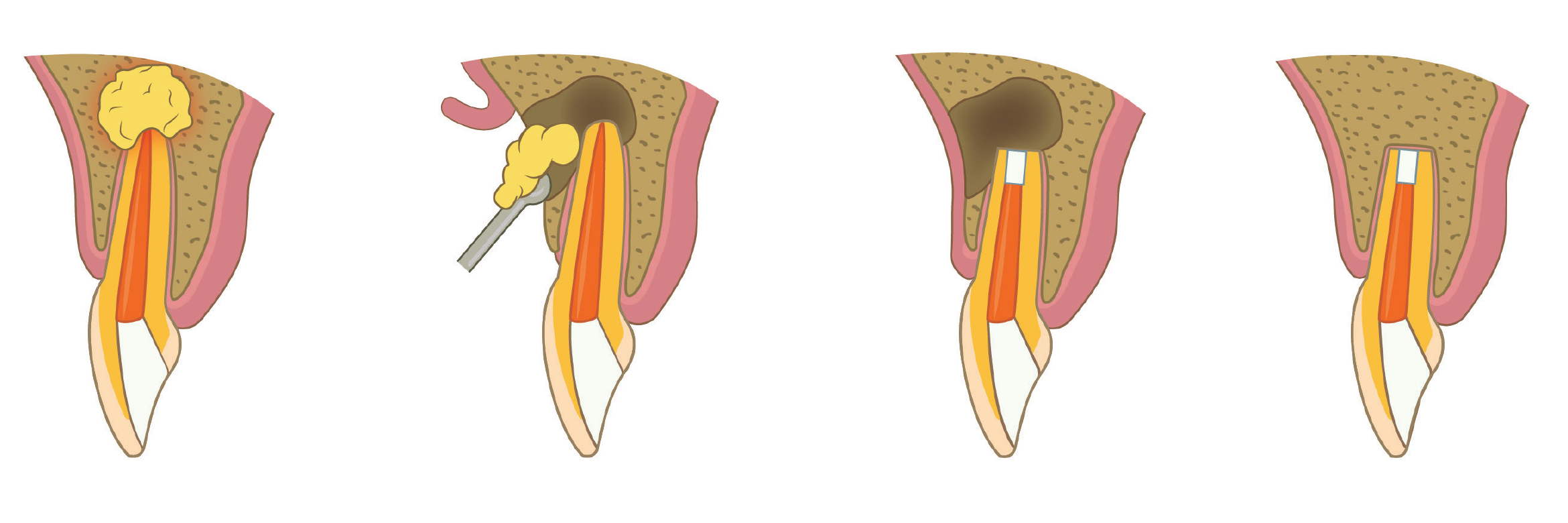
Illustration adapted from Guidelines for Periradicular Surgery 2020, Royal College of Surgeons of England and British Endodontic Society.
What is an apicectomy?
A direct approach to infection that persists around the end of a root.
Most infection inside a tooth is managed with root canal treatment. If inflammation or infection remains around the root tip, surgery may sometimes provide access that is not possible through the tooth.
The gum is gently moved aside, a small opening is made in the bone, the affected tissue and a short section of root tip are removed, and the root end is sealed. The area is then closed with stitches.
Why might it be considered?
Symptoms or a lesion remain around the root tip despite technically satisfactory root canal treatment.
Removing a post, crown or other restoration could weaken the tooth or create additional risk.
Direct inspection or a tissue sample may help investigate a suspected crack, perforation or unusual lesion.
The procedure
Source illustration: Guidelines for Periradicular Surgery 2020, Royal College of Surgeons of England and British Endodontic Society.
Infection or inflammation remains around the end of a root-treated tooth.
The area is numbed, then the gum is gently lifted and the affected tissue and root tip are removed.
The end of the root is prepared and sealed with a bioactive filling material.
The gum is closed with stitches and healing is checked at review appointments.
Before deciding
Most cases can be planned using careful examination and conventional dental X-rays. A small-volume CBCT scan may be recommended only where ordinary imaging does not provide enough information and the additional detail is clinically justified.
Recovery and review
Plan for a few quieter days while the area settles.
Swelling, bruising, tenderness and a little bleeding can occur. Symptoms commonly reduce over the first few days and are usually much improved within two weeks. You will receive written advice about cleaning, food, activity and pain relief.
Stitches and early healing are reviewed as appropriate. Longer-term review and radiographs are important because bone healing around the root tip takes time. No treatment can guarantee that the tooth will heal or remain comfortable indefinitely.
Clear fee information
Routine postoperative review and stitch removal are included. Consultation, X-rays, CBCT and reporting, histology, sedation and any subsequent filling, crown or other restorative work are charged separately where required. Your written treatment plan will confirm the fee that applies before surgery.
Your questions
No. The procedure is carried out under local anaesthetic, so the area is numb and you should not feel pain during treatment. You may feel some pressure or movement. Tenderness, swelling and bruising can occur afterwards, and we will explain suitable pain relief and aftercare.
No. Conventional dental X-rays provide enough information in many cases. CBCT is considered only when the extra three-dimensional information is clinically justified, for example where important nearby structures or the extent of a lesion cannot be assessed adequately.
It depends on the tooth, access and complexity. Your appointment length and the expected fee will be confirmed after assessment.
Contemporary techniques can have high healing rates, but the outlook depends on the tooth, existing root filling and restoration, lesion size, gum and bone support, access, whether this is repeat surgery and what is found during treatment. We will explain the realistic prognosis for your case.
A vertical root crack may not be visible on X-rays, including CBCT, and may only be found during surgery. If it makes the tooth unsuitable to retain, we may stop and discuss extraction and replacement options.
Many people prefer a quieter day or two, particularly if their work is physical or public-facing. Swelling and bruising vary, so plan around the advice given for your individual surgery.
Possibly. A sound seal at the top of the tooth is important for success. Any necessary restorative treatment will be planned and costed separately.
Start with an assessment
Contact our team and we will help arrange the appropriate consultation.